
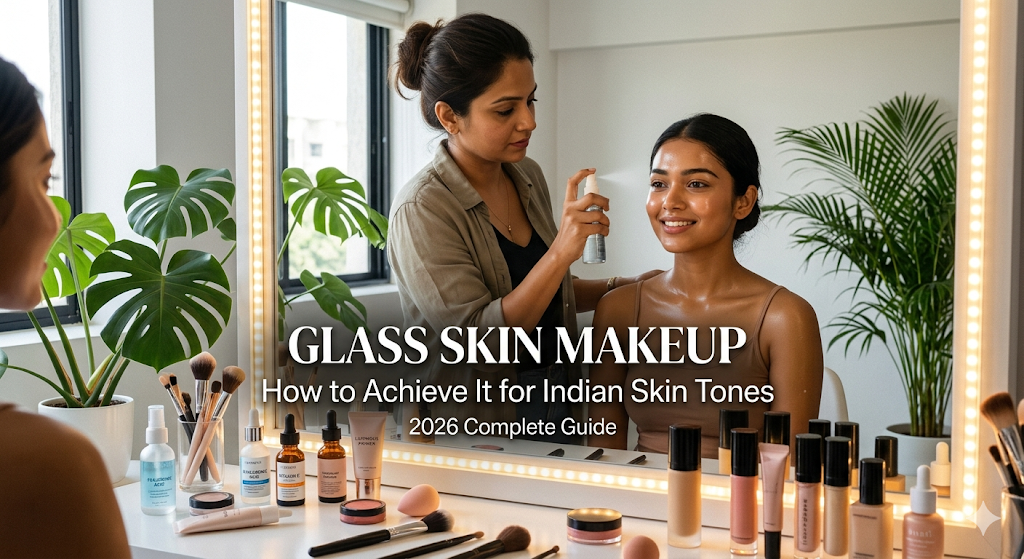
Glass Skin Makeup: How to Achieve It for Indian Skin Tones 2026 Complete Guide
If there’s one beauty trend that has completely redefined what “perfect skin” means globally it’s glass skin. Originating from South Korea’s K-beauty movement, glass skin refers to a complexion so smooth, luminous, and hydrated that it resembles a pane of glass. Flawless, reflective, impossibly dewy.
But here’s the question every Indian makeup lover and aspiring artist is asking: Can glass skin actually work on Indian skin tones?
The answer is an emphatic yes and this guide will show you exactly how.
What Is Glass Skin Makeup?
Glass skin is not a single product or step. It’s an entire skin philosophy. The goal is to create a complexion that looks lit-from-within deeply hydrated, pore-minimised, and naturally luminous without looking oily or greasy.
In makeup terms, glass skin involves:
- Intensive skin preparation (moisturisation and priming)
- A sheer-to-medium coverage, dewy-finish base
- Strategic highlighter placement (not shimmer luminosity)
- Absolutely no heavy powder or matte setting products
- A dewy setting spray to lock in the glow
The biggest difference between glass skin and a regular dewy makeup look? Glass skin starts before you open your makeup bag. The skin itself must be well-prepared and genuinely hydrated you can’t fake it with shimmer and highlighter alone.
Why Indian Skin Tones Are Perfect for Glass Skin
Here’s what the K-beauty industry won’t always tell you: Indian skin has natural properties that make glass skin easier to achieve than on many lighter skin tones.
Natural melanin gives depth. The luminosity of glass skin looks most striking on deeper, richer skin tones because melanin itself reflects light beautifully. On dusky, wheat, or deep brown Indian skin, that inner glow looks even more spectacular.
Indian skin’s natural oil production helps. Indian skin, particularly in warmer climates, tends toward more natural moisture and oil production which is actually a glass skin asset when managed correctly with the right products.
The contrast is stunning. Glass skin on a fair-skinned complexion can look flat. On medium-to-deep Indian skin tones olive, wheat, golden, dusky the effect is rich, dimensional, and breathtaking.
Step-by-Step: How to Achieve Glass Skin on Indian Skin Tones
Step 1: Skin Prep The Foundation of Everything
Glass skin starts 24–48 hours before you apply a single drop of makeup. The night before, double cleanse your skin (oil cleanser first, then a gentle foam or gel cleanser), apply a hydrating essence or toner, layer a Vitamin C serum for brightness, and lock it all in with a thick moisturiser.
On the day, start with:
- Hydrating toner tap into skin, don’t wipe
- Hyaluronic acid serum for Indian skin, apply on slightly damp skin to lock in moisture
- Lightweight moisturiser look for ingredients like ceramides, glycerin, and niacinamide
Pro tip for Indian skin: Niacinamide is your best friend for glass skin prep. It controls excess oil, minimises pores, and brightens the skin all essential for the glass skin effect.
Step 2: The Right Primer
Skip silicone-based, blur-heavy primers. For glass skin, you want a hydrating, luminising primer something that adds a subtle inner glow rather than filling pores. Look for primers with light-reflecting particles but no visible shimmer.
For Indian skin tones, choose a primer with a warm or neutral undertone to complement your natural skin’s golden-olive undertone. Avoid pink or cool-toned primers, which can look ashy.
Step 3: Choose the Right Foundation
This is the most important product decision for glass skin. You need:
- Serum foundation or skin tint not a full-coverage formula
- Dewy or satin finish avoid anything labelled “matte” or “long-wear”
- Shade matched perfectly for Indian skin, choose foundations with yellow or golden undertones
Apply with your fingers for the most seamless, skin-like finish. If using a brush, use a damp, rounded kabuki brush. Damp beauty blenders also work beautifully the moisture prevents the product from looking cakey.
Leave some areas uncovered. One of the biggest mistakes in glass skin makeup is applying foundation everywhere evenly. Instead, concentrate coverage where you need it (redness, pigmentation) and let natural skin show through on cheekbones and the bridge of the nose this creates the natural, skin-like quality that defines glass skin.
Step 4: Concealer Less Is More
Spot concealment only. Use a liquid, hydrating concealer under the eyes and on any spots. Never apply powder concealer or bake under the eyes this destroys the glass skin effect entirely.
For Indian under-eye tones (which tend toward warm purple, brown, or greyish), choose an orange or peach colour-correcting concealer as a base before your regular concealer. This neutralises the pigmentation beautifully without heavy coverage.
Step 5: No Heavy Powder The Glass Skin Rule
This is the step where most people go wrong. Traditional Indian makeup often involves heavy setting powder, especially for events and photography. Glass skin requires a completely different approach.
If you must set (for longevity), use a very small amount of translucent HD powder only on the T-zone the forehead, nose, and chin. Use a fluffy brush and tap off all excess before applying. The goal is to minimise shine, not create a matte finish.
The rest of the face cheekbones, temples, under-eye area gets zero powder. Let the dewy finish breathe.
Step 6: Sculpt with Cream, Not Powder
For glass skin, all contouring and blush should be cream-based, not powder. Cream blush, cream bronzer, and cream highlighter blend seamlessly into dewy skin and enhance the glass skin effect.
For Indian skin tones:
- Blush: Warm peachy-pink, terracotta, or deep rose tones
- Bronzer: Warm brown, never orange or red-toned
- Highlighter: Gold, champagne, or bronze tones avoid pink or silver highlighters which look ashy on deeper Indian skin
Apply with your fingertips for the most natural, skin-like blend.
Step 7: The Finishing Touch Dewy Setting Spray
A dewy setting spray is non-negotiable for glass skin. Spray it from arm’s length away (not close-up, which creates uneven wet patches), then gently press a dry sponge onto the skin to meld all products together.
This final step is what creates that seamless, “skin is the makeup” effect.
The Best Products for Glass Skin on Indian Skin Tones (2026)
| Step | Product Type | What to Look For |
| Prep | Hyaluronic acid serum | Fragrance-free, 1% HA |
| Primer | Luminising primer | Light-reflecting, no shimmer beads |
| Base | Serum foundation | Dewy finish, warm undertone shades |
| Concealer | Liquid concealer | Hydrating, flexible formula |
| Setting | HD loose powder | Translucent, micro-fine |
| Blush | Cream blush | Warm peach, rose, or terracotta |
| Highlighter | Cream highlighter | Gold or champagne tone |
| Finish | Dewy setting spray | Glycerin-based |
Can You Wear Glass Skin Makeup in India’s Climate?
A fair question India’s heat and humidity can be the enemy of any makeup look. Here’s how to make glass skin last in Indian weather:
- Use a mattifying sunscreen as the final skincare step, before primer this controls the base-level oil without adding heaviness
- Choose a silicone-based airbrush foundation underneath your dewy products in very humid weather
- Blot with oil-blotting paper rather than powder during the day
- Reapply setting spray rather than touching up with foundation
Learn Glass Skin and More at Bombay School of Makeup & Hair
Mastering glass skin is just one of the techniques covered in BSMH’s professional and personal makeup courses in Mumbai. Our expert faculty with 15+ years of active Bollywood and fashion industry experience teach you how to adapt every global trend to Indian skin tones, lighting conditions, and photography requirements.
Explore our Personal Makeup Course for personal styling skills, or our Professional Makeup & Hair Course if you’re building a career.
View more makeup tips and trends on our Blog or call us at +91 9930703881.